Saturday, January 16, 2010

Banning the burqa: progressing freedom or limiting it?

It’s been a while since I ranted. I read a stat the other day that 70% of blogs in the US haven’t been updated in 4 months. Better make sure that freshconsciousness doesn’t fall into that category.

You might have heard about how the French government is considering a law that would ban the burqa anywhere in public.

France Moves Closer to Banning Burqas

It wouldn’t ban the Muslim headscarves, just Islamic dress that covers the face. The proposed law states, "No one may, in spaces open to the public and on public streets, wear a garment or an accessory that has the effect of hiding the face.”

The French see it as a religion in the public sphere and as symbol oppression of women. “Here, it is widely viewed as a gateway to radical Islam, an attack on gender equality and other French values, and a gnawing away at the nation's secular foundation.” This isn’t unprecedented in Europe. France previously banned Muslim headscarves and other "ostentatious" religious symbols in the classrooms of French public schools, and Switzerland recently banned minarets.

This is a complicated topic and I’m somewhat conflicted. Ultimately, I think banning certain clothing is an affront to liberty and the freedoms western democracies were founded on. If I certainly can’t agree with Muslim women being forced to wear the burqa like they are in Saudi Arabia or Afghanistan, I also can’t agree with a government forcing women to not wear them.

The burqa may be a symbol of oppression to some people inside and outside of Islam, but not to everyone. And while some claim the burqa is a religious symbol, it’s also a cultural symbol to some. Some women claim they like to wear one, to show their pride in their culture, or to be more spiritual.


It seemed like most people who commented on the Huffington Post article agrees with the ban. Some raise the point that all governments regulated dress to some degree, and Germany even banned Nazi symbols. Good point; the issues are similar. Even though the burqa might not carry the same hate, violence, and evil, it does to some degree. So if you forced me to be consistent, even though banning swastikas is easier to digest, I guess I wouldn't support that either. The article states that the proposed law to ban burqas “cites public security concerns, thus includes all face-covering clothes, in a bid to head off challenges from those who might claim such a law would violate constitutional rules on individual rights…” So now we’re banning things out of fear? That makes it even worse. If fear for public safety is the reason they’re banning burqas or Nazi symbols, I can’t support that.
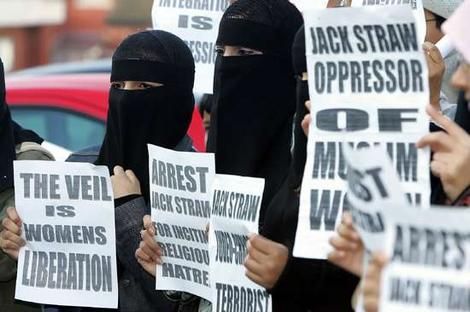


One poster commented that “Ban the burqua and ban all fundamentalist religious sects which express hostility to secular Western values and democracy.” Excuse me? Since when is BANNING things is “Western values?” Where does this stop? This puts liberty on a slippery slope where governments get to decide what constitutes “Western values” and force society to comply. That sounds more like fascism than democracy. It’s also an affront to diversity. In the name of assimilation and conformity, the French aren’t willing to accept people that are too different, cultures that challenge their secular world-view. They want to maintain their “French flavor.” Coming from a melting pot country, that sounds elitist, intolerant, and bigoted. Slip any further down this slope and you’re talking about banning religious or cultural practices. Additionally, as far as liberating women goes, it might have the opposite effect, keeping Muslim women even more hidden:

"We won't be able to leave the house," said Oumeima Naceri, a 19-year-old convert draped in black garments, including a filmy "sitar" veil covering even her eyes. "That frightens us enormously ... It's like asking us to go naked."


Muslim women should have the freedom to wear what they want. In progressive Muslim cities like Cairo and Istanbul, women can wear a scarf, a burqa, or nothing. (Granted, there may be some bad stigmas attached to women who don’t cover). We should help fight for this right, as way too many Muslim women don’t get a choice. We should assist Muslim women in their fight within Islam to force this change. Forcing a change from outside only increases atomicity and can sometimes lead people to dig their heals in and resist the outside pressure.

I think I’ve put forward a pretty good case that banning the burqa slights liberty, it does not expand it. However, I will leave you with a comment that almost made me change my mind:

IF you had been born female into a family that believes that you cannot go against Islam in any way--for instance the kind of family where one goes into the streets to protest against a cartoon drawn by some Danish guy (and how many thousand did exactly that?)

THEN you would have learned from a very young age that you don't challenge a religious obligation, you don't show any religious dissent whatsoever

THEN you would know that the person who feeds you and keeps you has all the power and could go ape-shit on your ass at any time

THEN you might be talked into a burka and feel safer with it than without it

THAT DOESN'T MAKE IT RIGHT

If France--where I live--we believe in religious dissent and freedom FROM religion in the public sphere. We know damn well that as soon as young Muslim girls go home they are subjected again to a steady regime of ask no question, comply, pray and obey. But we demand to see their faces and look into their eyes because they are people, not shadows.

Thursday, November 26, 2009

International conservation NGOs

So like a good liberal I was brousing The Huffington Post the other day. I came along this article: Ashley Judd: Please, Population Control is Not the Answer for Congo.

I posted a comment, this time with my credentials, and the author Georgianne asked to chat with me about international development NGOs working in the region. She sent me two interesting reports:

A Challenge to Conservationists


MID-TERM ASSESSMENT OF THE CENTRAL AFRICAN REGIONAL PROGRAM FOR THE ENVIRONMENT (CARPE
)

It brought me back to grad school. One of my professors, Dianne Rocheleau, used to tell us about this kind of conservation. She dubbed it “guns and fences conservation.” Erect fences, and guard the reserve with guns so none of those destructive peasants can get in. Besides being unethical, it just doesn’t work. I’d ask you all to boycott donating to these agencies, but unfortunately, these NGOs derive extremely little of their funding from private donations, so there’s little we can do as normal citizens.

I found the critiques of TNC interesting, as TNC is one of the conservation organizations in the US I respect the most. As opposed to some other big national and regional NGOs, they do work directly with local communities in the west. They pay attention to all science, not only the stuff that suits their cause, and they hardly every exaggerate or lie, which is the MO of many other organizations. They put their money where their mouth is, spending it on buying land and putting conservation easements in place instead of lobbying above the communities’ heads and suing agencies. This is how the conservation movement game is played in America. While The Wilderness Society and Colorado Environmental Coalition is hated by locals in rural Colorado (some for good reasons, some not), TNC is not viewed as a “radical environmental organization” and is (relatively) well respected by the rednecks. I definitely consider myself an environmentalist, but after working years with some of these big conservation NGOs, I’ve become quite jaded. Like international aid, it’s all about the money.

As the author Chapin infers, we must work with communities not only because building the capacity of these communities to prosper, but because no matter how many fences you put up, no matter how many men with guns guard your sanctuaries, the disenfranchised people will use their traditional resources and you won’t meet your conservation goals. I also liked the fact that Chapin mentions that the true goal of an NGO is to work yourself out of a job. This NEVER happens. That’s not the way The Aid Machine works.

It’s all about keeping The Aid Machine running. People have jobs that they want to justify. NGOs have to keep spending money, regardless of the effectiveness, or the money dries up. They take the money and hire more people. They flail around for several years because doing true community-driven conservation is hard. But they will never refuse the money and say “sorry, this project just isn’t working.” That would mean no more funding stream. This is why I call it The Aid Machine. It is self-perpetuating, always feeding itself. It hardly every shrinks, only grows. Chapin had some startling insights on where these NGOs get their money and how that relates to their mission. These groups HAVE to keep getting money to survive, and soon they don’t care where it comes from, or what projects it goes towards. They just need to spend it, or next year they don’t get any. This is the problem of international aid. It’s not about helping, it’s about spending.

As far as the assessment of the CARPE program, it seems to me working with local communities was never really a goal of this program in the first place. Sure enough, this is called out several times in the report.

“Progress in working with forest concessions and in establishing community based natural resource management (CBNRM) reserves is limited.”

“Capacity Building: The mix of NGOs and federal agency service providers has not effectively addressed the capacity building objective. NGOs have strengthened park management and surveillance capacity, but impact on Community Based Organizations (CBOs) and local NGOs has been much less effective.”

By focusing more on enforcement and less on communities, it becomes clear that these agencies are doing “guns and fences conservation.” It seems that inviting the local communities to participate in conservation isn’t even a goal of this program. Look at the second strategic design element:

“2. A set of mostly US-based organizations that work across landscapes in common thematic areas such as multiple-use planning, forest monitoring, policy and governance and uncontrolled hunting;”

More enforcement. No where in the strategic goals is anything about working with local communities; no where is there anything about poverty reduction. The people of Congo are largely ignored and forgotten.

I found the constraints that were identified quite interesting:

“The main constraints to progress at the landscape scale include: remoteness, difficult access to the sites, lack of an information base for planning/management, lack of infrastructure, lack of agreements in place to work with government agencies mandated to manage lands outside of PAs, low tourism potential, and low local partner capacity. In several landscapes, insecurity makes access impossible or dangerous in parts of the landscape.”

First, we are told it’s hard to get white people into these places, and it’s dangerous. Um, why not leverage the support of the local communities then? It is inferred that the natives are difficult. “If those damn Africans would just get with the program and build roads, quit fighting, and partner with us, we would be fine.” No sign that the program itself is the problem. To them, Africans are passive recipients of aid, not active agents in change.

It's really too bad international conservation NGOs play the game this way. No wonder aid to Africa isn't working.

Monday, October 26, 2009

H.R.2807 - America's Wildlife Heritage Act: Changing our public lands laws

CSU professor Barry R. Noon wrote The greatest good for the greatest number in Saturday's Denver Post. In this piece Noon advocates revising the laws that govern public land managent to emphasize resource protection over use. While I agree with his thesis that land management should shift from use towards conservation, I don’t believe rewriting our public lands laws is the way to accomplish that goal.

The laws and policies which currently guide our land management agencies already allow agencies to do the things you’re advocating. The two overarching laws governing use on Forest Service and BLM land (National Forest Management Act (NFMA) and Federal Land Policy Management Act (FLPMA)) direct agencies to manage lands sustainably and to protect natural resources. There is a lot of decision space to work with within the existing regulatory framework. How do you want “advance environmental stewardship on our public lands?” Stringent stipulations on uses? Closed to logging and oil and gas development? All these things and more can be done within existing laws.

Congress and the Obama administration already “have the opportunity to advance environmental stewardship on our public lands” through our existing laws. Congress can do almost anything they want. Want more wilderness? Updated oil and gas On Shore Orders? Congress can do this with the stroke of a pen; they don’t need an overhaul of land management laws. We can “develop land-use policies that emphasize science-based management of our public lands—that is, policies that promote science based tools to sustain fish and wildlife populations and the resources and ecosystems on which they depend” through existing laws. In fact, land management agencies are already doing these things. Recent studies on greater sage-grouse are leading to more stringent restrictions on oil and gas development. Agencies rely heavily on scientific data to make decisions. When they don’t, they lose lawsuits. Using science is necessary to show impacts of agency actions when complying with NEPA.

Let’s look specifically at the H.R.2807 - America's Wildlife Heritage Act. I’m looking at the summary here: http://www.govtrack.us/congress/bill.xpd?bill=h111-2807&tab=summary

America's Wildlife Heritage Act - Sets forth requirements concerning the maintenance of viable populations of existing native and desired non-native species within each planning area in the National Forest System's or the Bureau of Land Management's (BLM) public lands. Directs the Secretary of Agriculture and the Secretary of the Interior to adopt and implement a strategically targeted monitoring program for determining the status and trends of native and desired non-native species populations on System and BLM lands. Defines: (1) native species to mean species of plants and animals indigenous to a planning area; and (2) desired non-native species to mean those wild species of plants and animals that are not indigenous to a planning area but are valued for their contribution to species diversity or their social, cultural, or economic value.


Agencies already have a body of guidance regarding native species. It looks almost exactly like the broad, squishy language above, telling agencies natives are preferred while leaving room for non-natives. (Our politicians wouldn’t want to mandate that all species are native or their friends in the agriculture business would not be happy). Direction like this in a law is ambiguous and meaningless.

Requires the Secretaries to coordinate the management of planning areas of the System and the BLM with the management of the National Wildlife Refuge System and National Park System, other federal agencies, state fish and wildlife agencies, other state agencies responsible for management of natural resources, tribes, local governments, and non-governmental organizations engaged in species conservation. Requires the Secretaries to issue regulations implementing this Act within one year of its enactment.


We need a law just to tell land management agencies to work together? Is that really a good use of our legislature’s time and energy? Agencies already work together. There are processes in place (such as Cooperating Agency Status) that deal with agency cooperation.

As for NEPA, it’s a very simple law (it’s only a few pages) and should not be tampered with. NEPA says nothing about what course of action an agency should take. It does not give guidance on whether to allow use of resources or to preserve them. NEPA merely tells the agencies that they must make the public aware of the impacts of their actions and affords the public the right to participate in these decisions. No one can argue those are not very important things for a public land agency to do. It doesn’t matter how old it is, these important principles will always stand. NEPA should not be “polluted” with opinions on how to address specific resource uses. Policy, guidance, and land use plans should address those tough issues.

Maybe some tweaks around the edges could be warranted. But I would caution totally revamping our laws that govern public land management. The laws aren’t broken, only some administrations which implement them. This problem of mismanagement will not go away regardless of how many laws are changed or added. This effort might make folks feel good, but it means nothing. We would be better off with Obama’s Secretaries of Ag and Interior issuing guidance to the agencies which emphasizes protection of natural resources and makes certain practices/approaches which do this a priority. Their ability to do this is well within existing law. We saw how much Bush did within existing law (and some outside law) to make use a priority. Obama can do the same to further his administration’s environmental goals the opposite side of the spectrum.

Monday, October 19, 2009

Problems with sports culture in the US: Who is responsible?

Denver Post printed a nice piece by a high school athlete today entitled "Why I can't stand youth sports anymore." It made me think about sports culture in America.

I hear a lot of blame going around when it comes to sports in 21st century American culture. Sports is HUGE business. Absolutely enormous. Never mind the billions the NFL makes every year, now make believe (fantasy) football is now a billion dollar business. The negative aspects are pretty apparent in all levels of sports culture: hyper-competitiveness in youth sports, devastating injuries to young athletes, parents assaulting referees, athletes making it through college not knowing how to read or write, poor sportsmanship, athletes who have learned that violence and aggression is the way to address life's problems, etc. Sports headlines crowd out “more important” news as the media fans the flames of every sports story. ESPN covers our 11 year-olds playing little league like there’s nothing more important in their lives than winning, and we talk about how there’s no child exploitation in America. The list goes on and on. I'm a huge sports fan, and I realize there are many positive aspects too. However, I think most Americans can agree with this well-written piece by Scott Martin that these negative aspects are getting worse.

So who’s to blame? The parents? The kids? The agents? The athletes? The owners? The media? To some extent, all of the above. However, in my humble opinion, none of those parties are more to blame than the American sports consumer. That’s me, you, and millions of Americans who park our butts on the sofa or in a stadium seat every weekend. We feed the gargantuan monster that has become sports in America. Make no mistake about it WE drive this bus. The negative aspects are reflections of American’s obsession with sports. These negative elements are manifestations of the market reacting to millions of consumers and their dollars.

So what will it take to change? What can we do to try to reverse some of these trends? To some extent, we can change things on the ground in the neighborhoods in which we live. Grassroots action can make your child’s soccer program better. However, to make large systemic changes to US sports culture, I fear that only a large shift in sports consumption will do the trick. People need to stop watching and stop attending. I, for one, don’t see that happening. I, for one, am not about to stop watching sports. As long as the US consumer continues to demand sports, parents will continue to drive their kids too hard and the media will continue to have a heyday every time Brandon Marshall has something to say.

It’s easy to point the fingers at others. But I feel that I’m a hypocrite if I attack sports culture when I’m sitting happily on the sofa soaking it up for 6 hours every Sunday. Anyway, just something to think about.

Saturday, October 17, 2009

Professional Rant of the Week: Garrison Keillor

Petulance and the Peace Prize
By Garrison Keillor

Evidently some people were disappointed that Dick Cheney didn't receive the Nobel Peace Prize, and believe me, I sympathize. I thought Philip Roth should've gotten the literature prize instead of that grumpy Romanian lady with the severe hair. But it was Mr. Obama whom the Norwegians wanted to come visit Oslo in December and stand on the balcony of the Grand Hotel and wave to the crowd along Karl Johans Gate. Face it, Mr. Obama is going to draw a bigger crowd than Mr. Cheney would have.

When a man has shot somebody in the face with a shotgun, people are going to be reluctant to line up en masse in his presence lest he get excited again. As for Mr. Cheney's boss, he was an unlikely pick for the Peace Prize after it was revealed by a White House speechwriter in a recent memoir that Mr. Bush once said, "I whupped Gary Bauer's ass." Boasting about ass-whupping is not the mark of a Nobel Peace Prize winner. The correct word is "whipping."

Going to Oslo in December and sitting through a black-tie banquet with a bunch of wooden-faced Norwegians and eating herring and delivering a speech larded with bromides about international cooperation and no jokes is not what I'd consider a whee of a good time, frankly. Oslo is rather dark and murky in December. The sun rises during the first coffee break and sets right after lunch and this does not make for a festive mood.

Some conservative pundit suggested that the president should've declined the prize, but it is not gracious to reject a compliment. One should accept it with becoming modesty, as Mr. Obama did, that's what your mother brought you up to do. The prize isn't about you, it's about Peace, or Literature, or Homecoming, or Champion Hog, or Male Vocalist of the Year, so walk up there and smile for the cameras, say thank you and sit down.

The wailing and gnashing of teeth that you hear among Republicans is 68 percent envy and 32 percent sour grapes. Here is an idealistic, articulate young president who is enormously popular everywhere in the world except in the states of the Confederacy, and here sit the 28 percent of the American people who still thought Mr. Bush was doing a heckuva job at the end, gnashing their teeth, hoping and praying for something horrible to happen such as an infestation of locusts or the disappearance of the sun, something to make the president look bad, which is not a good place for a political party to be, hoping for the country to slide into chaos. When you bet against America, you are choosing long odds.

A person can run down the list of all that's wrong with this country, including the lobbyists who cross back and forth from public service to influence-peddling like alligators on the golf course, or the bankers who lost their minds in the great mortgage mania, but the country has a history of rising to challenges and turning away from demagogues and doing what needs to be done. Because we are a passionately patriotic people, infused with a love of our history and our land, and so we have limited patience for fools, such as the ones who now dominate the right.

Conservatism is a powerful strain in American life that ordinarily passes as common sense. Save for a rainy day. Don't foul the nest. Don't burn your bridges. Don't sacrifice the future for short-term profit. But when it contradicts itself and becomes weighted down with bigotry and cynicism, then it doesn't hold water any more.

F. Scott Fitzgerald said, "The test of a first-rate intelligence is the ability to hold two opposed ideas in mind at the same time and still retain the ability to function." And conservatives tried to keep functioning through the Bush administration but the contradictions wore them down, and last fall, when the federal government wrote a blank check to stave off collapse of the financial sector, conservative principles came crashing to the ground, and now all they have in common is that they don't like President Obama. OK, but resentment of an American president being honored by the Norwegians is not a good point from which to build a Republican revival. Petulant fury isn't a winning hand in politics. Get over it.

Raiders’ shitty attitude direct result of Al Davis’ actions

So, my Oakland Raiders are the worst team in the NFL. Never mind that a few other teams are winless—they’ve played much better than Oakland. At least they still try. The Raiders have already given up, illustrated by that horrible performance against the Giants. One would think the lack of effort lies with the players, right? Not necessarily. Remember in Raiderland everything goes back to Al. Some players might give 100% at first, but they soon get extremely discouraged by Al’s actions. Here’s my thoughts on how low morale and zero effort goes directly back to Al Davis:

1) Davis drafts players based purely on their physical skills. He doesn’t care one iota about leadership skills, locker-room dynamics, drive, effort, love of the game, studying the game, etc. How can we build a franchise that wants to win when the players Al brings in don’t care?

2) Al pays underperforming players HUGE contracts. The fact that JaMarcus, Javon Walker, Tommy Kelly, etc. are making more than players who deserve it is obviously a blow to morale.

3) The coaching staff is inept and/or hamstrung. Preparation is bad. The game plan is bad. The play calling is suspect. The coaches also don’t care. Al doesn’t pay coaches well, and no coaches want to be puppets. So the players are stuck with leaders that can’t help them pull out of a shitty season. However, if we happened to find a diamond in the rough, or if a coach makes the right decision, Al vetoes it. Coaches must implement the game plan Al Davis wants. I’m sure players get frustrated with Al’s obsession with the long ball game of the 1970s. D lines and D secondaries are too good to make this the foundation of a football team in the 21 century. But coaches are not allowed to stray from Al’s MO. Coaches are puppets that can’t fix the problems, so why should the players play hard for them?

4) We all know Al plays favorites and has his “pets.” There is no punishment for bad play and there’s no little reward for good play. JaMarcus would be sitting on the bench if he were on any other team in the NFL. But Al won’t have that. He was mad when Kiffin didn’t play him earlier. This is clearly discouraging for players. Players are saying “well, if they put up more than 14 points on us, this game is over, so why try after we get down?” Once Chaz gets back, do you think Al would let Cable sit Darrius Heyward-Bey like he should? Maybe, but somehow I doubt it. How do you think that makes Higgins, Walker and especially Murphy feel? Why play hard when you’ll get benched for Al’s new speedy toy that clearly isn’t ready to start in the NFL? You have to have an incentive to play hard, and that incentive is missing in Oakland.

5) They know their owner and sole decision maker won’t correct the problem. The last 7 years tell a clear story. Things in most losing franchises eventually get better if you stay patient. No one lets their team wallow in horridness forever. History has shown that’s not the case in Oakland. No other team in recent memory has been this bad for this long. There’s NO HOPE because people know Al is an incompetent leader and they know nothing will get fixed.

I’m not excusing players for quitting. It is partly their fault. However, when looking at this issue deeper, it becomes apparent that Al Davis is a major factor in poor morale and no effort.

The Rams, Chiefs and Bucs clearly give more effort and show more spirit than the Raids. Embarrassingly enough, I’m really jealous of the Detroit Lions right now. They’ve got a promising young coach who is committed to changing the losing culture of the franchise. They’ve got a young QB who wants to play there and who gives 100% during and between games. You can tell they scrap and fight in every game, even against teams that are supposed to blow them out. How freaking wrong is it that any team should envy the Lions?

Thursday, September 17, 2009

Are Obama haters racist?

Since Joe Wilson’s idiotic outburst during President Obama’s heath care speech, there has been renewed interest in the issue of Obama’s critics being racist. The charge was leveled by Maurine Dowd and Jimmy Carter. Like many race issues, it’s set off a firestorm.

There’s no excuse for some liberals leveling the charge of racism against Obama critics. It bothers me when anyone cries “RACIST!” without any evidence. It bothers me when this comes from Al Sharpton and it bothers me when it comes from Glenn Beck. They are exactly the same in my book. Everyone needs to relax a bit and not throw around the racist work lightly.

However, the level of hatred we’re seeing towards Obama is unparalleled. Clinton did not receive this level of scorn, not even close. My most objective accounts, Obama’s policies are quite in line with Clinton’s moderate policies. Progressives are actually quite peeved at Obama for taking the middle road on too many issues. Obama is backing off from the public option in health care reform, kept Bush’s Sec of Defense, we still have troops overseas in two wars, there are still detainees in Gitmo, and we still don’t have any financial reform. Any fool arguing the Obama is an off-the-deep-end radical liberal simply ignores all facts and reality. If people were sick of “socialism” and government spending, where were all the protests when Bush pasted TARP? Where were the Hillary is a Nazi signs when she was pushing for health care reform?

The majority of Americans opposing Obama are not racist. They have some legitimate concerns. But I look at the extreme hatred coming from some on the right and I clearly see some element of irrationality. When you ask some of these nuts why they hate Obama so much, spittle flies from their mouths and they rant about how he’s a Muslim racist Marxist. This simply does not jive with any factual information at all, there’s obviously some strong bias there that affects the way they perceive Obama. I see this often, idiot lemmings carrying around Obama is Nazi signs. You can’t tell me there isn’t something in these people’s heads that prevents them from thinking rationally. I think in many cases that bias is racism.

I very much realize there was a lot of hate towards Bush. There were also strong feelings against Clinton after the Monica scandal. However, this is not irrational hatred to me because it was linked to a specific event. This is an important distinction. Much of the hate I see for Obama is linked to no specific issue, action or policy. I could also argue that much of the hatred towards Bush was based in his policies, namely his foreign policies. But when some (not all) Obama haters are asked why they dislike Obama, they can’t put their finger on anything specific. “He’s a socialist” they might say, or any other number of popular sound bites. What makes him a socialist? What has he done that’s so radically left? No Wall Street reform yet. He’s shown quite a bit of good old politician loyalty to corporate interests. If folks could better explain their issues to me, it wouldn’t be irrational hatred. But unfortunately many cannot and in too many instances we're not having a constructive discussion. In fact, we even saw this strong hatred during the campaign before Obama had done anything as a president and admittedly little as a Senator. To me, this is the difference between hate towards Clinton and Bush and hate towards Obama. Not tying this hate to any specific event makes me think there’s something else at work in their heads, some bias they can’t get past.

Some of my liberal friends need to largely keep the word “racist” out of their vocabulary and use it only when truly warranted. Otherwise it hurts liberals and Obama more than it helps. Everyone can agree that SOME people who dislike Obama are racist and I hope everyone agrees that throwing around the word “racist” with reckless abandon doesn’t help a bit. We should celebrate our common ground on this issue and move on from a pretty much petty argument about how many people are racists.